
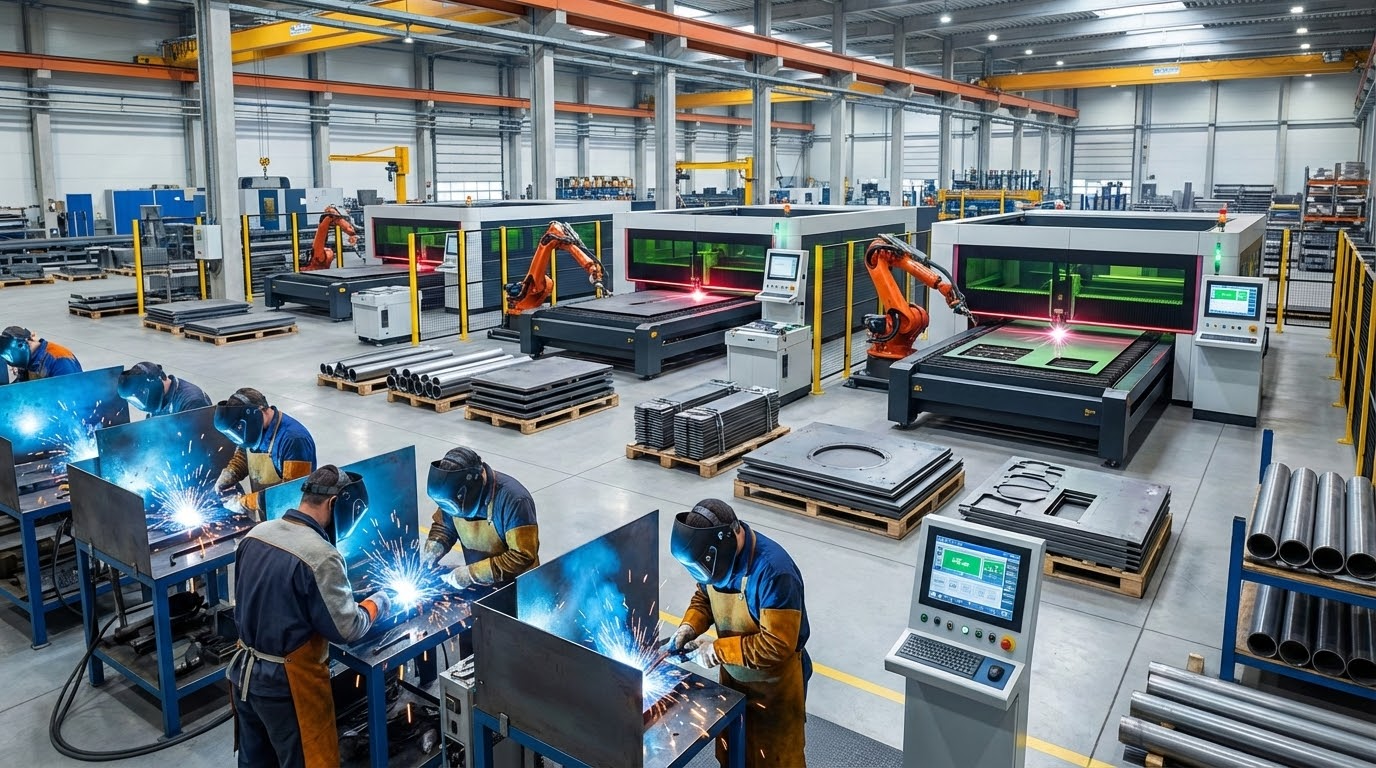
Metal fabrication is a fundamental process in manufacturing where raw metal materials are transformed into finished products or components. As industries evolve, understanding metal fabrication has become essential for grasping how modern products—from vehicles to machinery—are created efficiently and precisely. This introduction provides clarity on the topic for those new to the field, outlining its basic role and significance.
What is Metal Fabrication?
Metal fabrication involves a series of processes that cut, shape, and assemble metal materials into usable structures or parts. These processes include cutting techniques like laser or shearing, forming methods such as bending, and joining procedures like welding. The goal is to produce components that meet specific design and quality requirements, often customized to suit various industrial applications.
Importance of Metal Fabrication in Modern Manufacturing
Metal fabrication is vital to modern manufacturing because it enables the production of durable, precise, and complex metal components that serve as the backbone for countless products and infrastructure. It supports scalability from single custom parts to high-volume production runs, ensuring that industries can meet demand with consistent quality. Furthermore, efficient fabrication processes contribute to reducing waste, optimizing material use, and enhancing overall manufacturing efficiency.
Common Misconceptions About Metal Fabrication
Beginners often misunderstand metal fabrication by confusing it with general metalworking or assuming it involves only a single process like cutting. Another common misconception is underestimating the importance of selecting appropriate fabrication methods based on metal types and project specifications. Additionally, overlooking quality control steps or neglecting safety protocols can lead to errors, defects, or hazards during fabrication.
Advancements in Metal Fabrication
The metal fabrication industry is increasingly integrating advanced technologies such as automated machinery, computer numerical control (CNC) systems, and laser processing to improve precision and productivity. Sustainability is also gaining focus, with manufacturers adopting eco-friendly practices that minimize waste and energy consumption. As manufacturing sectors evolve, metal fabrication continues to adapt by embracing digital tools and innovative techniques that enhance flexibility and meet growing industry demands.
Types of Metal Fabrication Solutions
Metal fabrication solutions typically fall into three broad categories: traditional/manual fabrication, CNC and automated fabrication, and hybrid/custom fabrication. Traditional/manual fabrication relies on skilled artisans using hand-operated tools and conventional machinery such as shears, brake presses, and welding equipment. It offers flexibility for prototyping and unique custom projects but can be slower and less consistent at scale. CNC and automated fabrication employ computer-controlled machinery including laser cutters, robotic welders, and CNC mills to achieve high precision, repeatability, and volume with reduced human error. These methods require upfront programming but excel in efficiency for large production runs. Hybrid fabrication combines the benefits of both, using automation for repetitive tasks alongside manual expertise for complex or specialty components. Choosing between these solution types depends on factors like order volume, complexity, required precision, and material characteristics.
| Fabrication Approach | Advantages | Disadvantages | Best Use Cases |
|---|---|---|---|
| Traditional / Manual | High flexibility; good for prototypes and custom jobs; lower initial cost for simple equipment | Labor-intensive; slower; potentially less consistent quality; limited scalability | Small batches; custom or intricate projects requiring artisanal expertise |
| CNC / Automated Fabrication | High precision and repeatability; faster production times; efficient for high volumes; reduced scrap | Higher capital expenditure; requires programming and technical skills; less flexible for one-offs | Large-volume manufacturing; standard parts with tight tolerances |
| Hybrid Fabrication | Balances automation efficiency with manual customization; adaptable to complex projects | Complexity in workflow management; potentially higher costs due to mixed processes | Medium volumes; projects requiring both precision and custom finishing |
This neutral matrix highlights the trade-offs manufacturers must evaluate to align fabrication approaches with project requirements and operational capacity.
Key Considerations When Choosing Metal Fabrication Solutions
When assessing metal fabrication solutions, manufacturers should consider:
- Material capabilities — including sheet and plate thickness ranges, types of metals supported, and forming limits;
- Production scale — whether the operation supports low-volume prototyping or high-volume mass production with just-in-time delivery;
- Precision and quality control — including machine accuracy, welding certification, inspection processes, and finishing options;
- Flexibility and lead times — the ability to handle design changes, custom runs, and rapid turnaround;
- Technological integration — the extent of automation, CNC programming, and use of laser cutting or advanced forming machinery;
- Cost-effectiveness — capital investment, operational efficiency, and scrap minimization;
- Service offerings — range from raw material supply to assembly and post-processing capabilities.
Balancing these factors in light of project specifications ensures selecting the optimal fabrication strategy without compromising quality or timelines.
Case Study: Hybrid Fabrication in Automotive Components Manufacturing
A mid-sized automotive components manufacturer needed to transition from in-house manual welding and cutting to a hybrid fabrication solution. They incorporated CNC laser cutting combined with certified welders for final assembly. This shift allowed the company to maintain customization for specialized parts while increasing throughput by 30%. Moreover, improved precision reduced rework rates and material waste. The balanced approach helped the manufacturer meet tighter production deadlines without sacrificing quality, demonstrating how hybrid fabrication can deliver operational scalability and customization simultaneously.
Frequently Asked Questions (FAQs)
Q1: What fabrication methods are best suited for high-volume versus custom projects?
A1: High-volume projects benefit most from CNC and automated fabrication offering speed and consistency, while custom or low-volume jobs often rely on manual fabrication for flexibility.
Q2: How do material types influence the choice of fabrication techniques?
A2: Different metals (steel, aluminum, copper) have distinct forming and cutting properties that affect process selection; for example, laser cutting suits thin stainless steel but may be adjusted for thicker plates.
Q3: What quality control measures should I expect from a metal fabricator?
A3: Industry-standard certifications for welding, dimensional inspections, and finishing checks ensure component reliability and compliance with project specs.
Q4: How is technology evolving metal fabrication today?
A4: Automation, CNC programming, and laser processing enhance precision and throughput while reducing waste and labor needs.
Q5: What factors determine the cost-effectiveness of a fabrication approach?
A5: Key considerations include production volume, material utilization, scrap rates, lead times, and the complexity of parts fabricated.
Q6: Can fabrication processes be combined for complex manufacturing needs?
A6: Yes, hybrid approaches integrate both manual and automated processes to balance precision, customization, and volume scalability.
Why Choose Success Metal Manufacturing?
Success Metal Manufacturing stands out as the premier metal fabrication provider in North America due to our unique combination of advanced technology and certified craftsmanship. Our integrated capabilities—from precision laser cutting to expert welding—allow us to deliver solutions tailored precisely to your project’s scale and complexity. Unlike other providers, our hybrid fabrication approach balances automation efficiency with artisanal skill, ensuring both high-volume consistency and custom flexibility. Trusted by industry leaders such as Mercedes-Benz and Wonderbrands, we guarantee reliability and exceptional quality grounded in decades of proven expertise. Choosing Success Metal Manufacturing means partnering with a forward-thinking provider committed to transparency, timely delivery, and exceeding your exact specifications every time.
Pricing Philosophy
Our pricing reflects the meticulous balance between technology investment and hands-on expertise that defines cost-effective metal fabrication. By leveraging state-of-the-art CNC and laser processing equipment alongside certified welding teams, we optimize material usage and reduce scrap rates—delivering economic value over the full production lifecycle. Our scalable production model accommodates both small custom prototypes and expansive high-volume runs without sacrificing quality or lead times, allowing clients to achieve competitive pricing through efficiency and consistency. Furthermore, our comprehensive service suite—from raw material sourcing to finishing—consolidates your supplier chain, reducing hidden costs and project management overhead. This value-based pricing approach means you pay for precision, reliability, and integrated support rather than fragmented services.
Quality Assurance and Risk Mitigation
To reduce your risks and ensure complete confidence in choosing Success Metal Manufacturing, we back our metal fabrication services with robust quality guarantees and transparent processes. Our certified C.W.B. welders and rigorous quality control protocols—including dimensional inspections and finish verifications—ensure every component meets your exact specifications before delivery. We offer flexible assessments and consultations upfront to align fabrication methods with your project’s material and volume requirements, minimizing costly revisions after production begins. Just-in-time delivery and responsive communication keep your schedule on track. Additionally, our commitment to continuous improvement means we stand ready to address any concerns post-delivery promptly. With Success Metal Manufacturing, you gain a trusted manufacturing partner delivering consistent results and peace of mind.
Get Started with Success Metal Manufacturing
Ready to bring your metal fabrication project to life with a proven North American leader? Contact Success Metal Manufacturing today for a detailed quote or to discuss how our custom and high-volume solutions can meet your manufacturing goals. Email us now at sales@successmetalmanu.com or call to speak directly with our expert team. Let’s build success together with precision, reliability, and cost-effective expertise—start your project with us now!
