

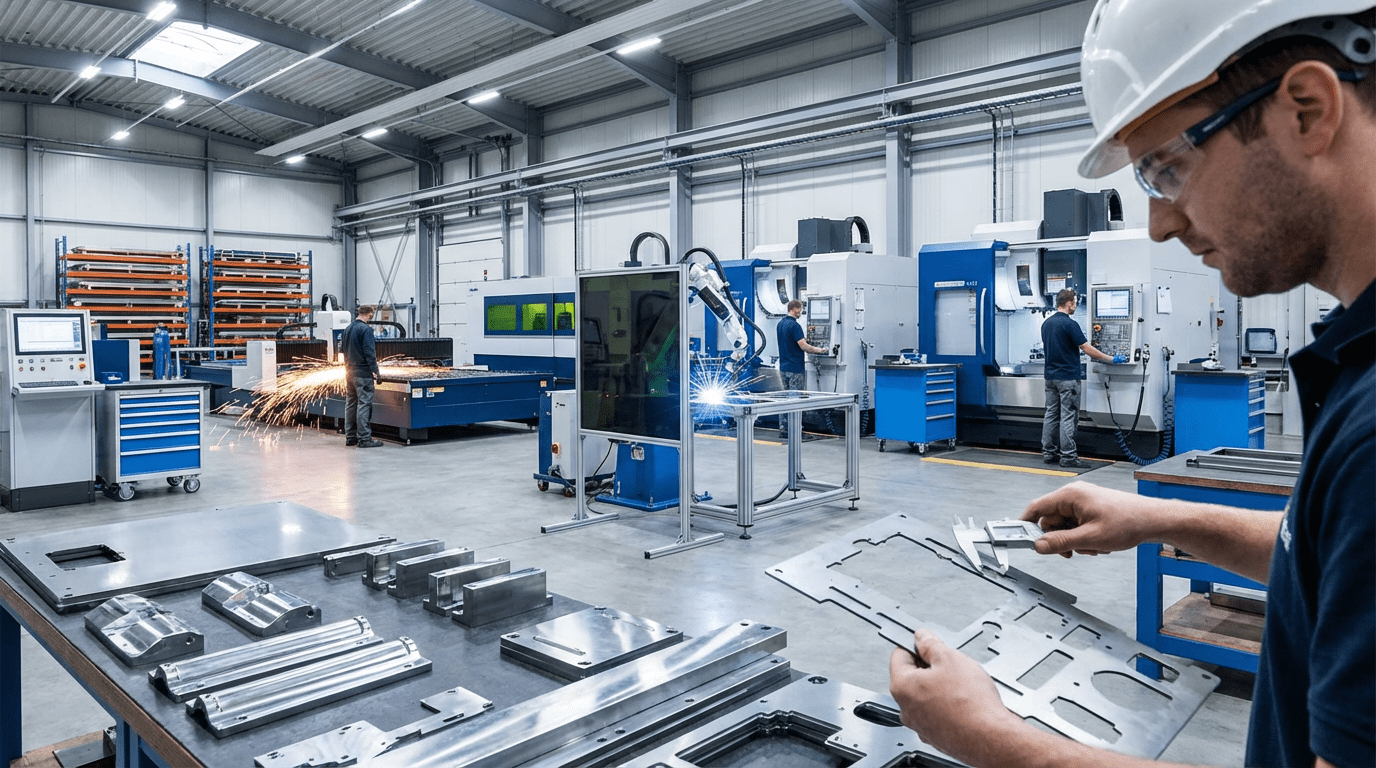
Metal fabrication is a foundational process in manufacturing, involving cutting, shaping, and assembling metal components to create products or structures. For many industries across Canada, the demand has shifted towards precision metal fabrication, a specialized approach that emphasizes accuracy and tight tolerances to meet complex design and quality requirements. If you’re new to this field, understanding what precision metal fabrication entails and why it matters is the first step toward grasping its role in modern manufacturing.
What is Precision Metal Fabrication?
Precision metal fabrication refers to manufacturing processes that produce metal parts with extremely exact measurements and tight tolerances. Unlike general or traditional metal fabrication, precision fabrication uses advanced machinery such as CNC (Computer Numerical Control) machines, laser cutters, and robotic welders to achieve high accuracy. This precision ensures that each component fits perfectly within larger assemblies, meeting stringent quality standards demanded by industries such as aerospace, automotive, and medical devices. Typical processes include laser cutting, CNC machining, custom forming, shearing, and certified welding, all executed with a focus on repeatability and detail.
Why Precision Metal Fabrication Matters
The importance of precision metal fabrication lies in its ability to deliver components that perform reliably within critical applications. High precision reduces the risks of assembly errors, improves product longevity, and supports the functionality of complex systems. In Canadian manufacturing sectors, precision fabrication enables companies to meet regulatory and industry standards while optimizing production efficiency. Additionally, precise components often require less rework and quality testing, contributing to improved cost-effectiveness and faster project timelines in large-scale manufacturing environments.
Common Misunderstandings for Beginners
Beginners often conflate traditional metal fabrication with precision fabrication, assuming they are interchangeable. However, traditional methods may allow wider tolerances and less automation, potentially leading to inconsistencies. Another common misunderstanding is underestimating the role of quality control and certification in precision fabrication, especially within Canadian industry regulations. Additionally, novices may overlook the significance of selecting appropriate fabrication processes and machinery to match material types and design complexities, which is crucial for achieving desired precision.
Current Trends in Canadian Metal Fabrication
The metal fabrication industry in Canada is evolving with increased adoption of digital technologies such as automated CNC machining, laser processing systems, and robotic welding stations to enhance precision and throughput. There is growing emphasis on compliance with national quality standards and certifications to ensure product reliability. Sustainability is becoming a focus, with fabricators exploring environmentally friendly finishes and waste reduction strategies. Furthermore, expanding applications in sectors like renewable energy, medical devices, and advanced manufacturing are driving innovation and demand for highly precise metal fabrication capabilities.
Main Types of Metal Fabrication Solutions
When evaluating precision metal fabrication options, the main solution types to consider include:
- Traditional Fabrication vs. Precision Fabrication — Traditional approaches rely more on manual processes with broader tolerances, while precision fabrication uses advanced CNC machines, laser cutting, and robotic welding to achieve tighter tolerances and repeatability.
- Custom Fabrication vs. High-Volume Production — Custom fabrication suits specialized, lower volume parts with complex geometries, whereas high-volume production focuses on mass manufacturing standardized components efficiently.
- In-House Fabrication vs. Outsourced Services — Some manufacturers maintain internal fabrication capabilities to directly control quality and timelines; others outsource to specialized vendors offering expertise in specific processes or technologies.
- Process-Specific Solutions — These include laser cutting for intricate shapes, CNC machining for tight dimensional control, shearing for sheet metal cutting, forming with brake presses, and certified welding for structural integrity. Each process can be standalone or combined to meet project demands.
Comparison Table of Fabrication Approaches
| Approach Type | Key Features | Advantages | Limitations |
|---|---|---|---|
| Traditional Fabrication | Manual/semiautomatic tools, wider tolerance | Lower upfront costs, simpler parts | Less precision, higher variability |
| Precision Fabrication | CNC, laser cutting, robotic welding | High accuracy, repeatability | Higher equipment and setup costs |
| Custom Fabrication | Small batch, tailored designs | Flexible, suits complex parts | Longer lead times, higher unit cost |
| High-Volume Production | Automated lines, standardized parts | Economies of scale, faster output | Less customization, tooling needed |
| In-House Fabrication | Internal teams and equipment | Greater control over quality | Higher fixed overhead |
| Outsourced Fabrication | Specialized vendors with niche capabilities | Access to latest tech and expertise | Less direct control, coordination |
| Laser Cutting | Precision sheet metal cutting | Complex shapes, tight tolerances | Material thickness limitations |
| CNC Machining | Controlled cutting/drilling on metal parts | Versatile, high precision | Slower for very thick or large parts |
| Shearing | Straight cutting of sheet metal | Fast, cost-effective for simple cuts | Limited to straight cuts |
| Forming (Brake Presses) | Bending/forming sheet or plate metal | Large parts produced to spec | Tooling and setup time |
| Certified Welding | Structural joining by certified welders | Strong, high-quality joints | Skilled labor required |
Key Criteria for Choosing the Right Fabrication Approach
- Tolerance and Accuracy Requirements: Determine the acceptable dimensional deviations and choose processes that guarantee needed precision.
- Volume and Scale: Low-volume custom parts may justify different methods than high-volume runs demanding efficiency.
- Material Type and Thickness: Compatibility with metals (steel, aluminum, etc.) and thickness affects process selection, such as laser cutting limits or bending capabilities.
- Complexity of Design: Intricate shapes may necessitate CNC machining or laser processing versus simpler shearing and forming.
- Quality Control and Certifications: Assess the provider’s quality management systems, certification standards (e.g., CWB welding certification), and inspection capabilities.
- Lead Time and Delivery: Consider production speed requirements and whether the provider supports Just-in-Time delivery.
- Cost Considerations: While cost is important, it should be weighed alongside quality and technical fit to avoid compromises on performance.
- Technological Capability: Evaluate the machinery, automation level, and digital integration to align with your project’s precision needs.
- After-Sales Support and Flexibility: The ability to accommodate design changes or provide finishing services adds value in ongoing production scenarios.
Case Study: Agricultural Equipment Manufacturer
A Canadian agricultural equipment manufacturer required precision laser-cut and welded components for a new tractor model. Initially, they considered traditional fabrication methods, but concerns over inconsistent fit and assembly delays prompted exploration of higher-precision solutions. They partnered with a fabrication provider offering certified welding and advanced laser processing with tight tolerances. This resulted in components that consistently met design specifications, reducing assembly rework and improving production timelines. The provider’s capacity for high-volume runs with quality control ensured scalability for the manufacturer’s growing demands without sacrificing part integrity.
Frequently Asked Questions
Q: How do I determine if precision fabrication is necessary for my project?
A: Analyze your component’s function, assembly requirements, and tolerance thresholds. High-performance, safety-critical, or tightly assembled parts often warrant precision techniques.
Q: What are the trade-offs between outsourcing fabrication versus maintaining in-house capabilities?
A: Outsourcing can provide access to specialized equipment and expertise without large capital investment, but may introduce communication or scheduling complexities. In-house offers direct oversight but requires ongoing investments in skilled labor and machinery.
Q: Can different fabrication processes be combined?
A: Yes, many projects integrate laser cutting, forming, machining, and welding for complex parts. Coordinating these steps enhances flexibility and precision.
Q: How important is certification in fabrication?
A: Certifications like CWB ensure adherence to industry standards, which is critical for regulated sectors to guarantee safety, quality, and compliance.
Q: What role does finishing play after fabrication?
A: Finishing services like powder coating or galvanizing protect parts against corrosion and wear, contributing to the longevity and aesthetic quality of the final product.
Why Choose Success Metal Manufacturing?
Success Metal Manufacturing stands apart as North America’s leading precision metal fabrication provider by combining cutting-edge technology with certified craftsmanship. Our advanced laser processing, CNC machining, and CWB-certified welding ensure unparalleled accuracy and repeatability for both custom and high-volume production runs. Trusted by industry leaders like Mercedes-Benz and Loblaws, we deliver consistent quality without compromise. Our comprehensive in-house capabilities—from raw material sourcing through finishing services—streamline your supply chain and reduce delays, giving you a single reliable partner. We prioritize transparent communication and Just-in-Time delivery to align perfectly with your production schedule and quality standards.
Pricing and Value
Our pricing reflects the true value of precision fabrication tailored to your exact specifications and volume requirements. By leveraging state-of-the-art equipment and streamlined processes, we minimize waste and inefficiencies that typically inflate costs elsewhere. The investment you make covers not only superior materials and expert labor but also rigorous quality control and certification compliance, which reduce costly rework and downtime in your downstream operations. Whether you need one custom component or thousands of parts, our scalable solutions ensure competitive pricing while maintaining uncompromising quality and delivery reliability.
Quality Assurance and Support
We stand firmly behind the integrity of every metal component we produce. With Success Metal Manufacturing, you receive full project transparency and detailed quality inspections backed by CWB certification to ensure the highest standards. Our team works collaboratively throughout the manufacturing process, providing timely updates and addressing any issues proactively. To reduce risk, we offer initial prototype runs and sample assessments allowing you to validate specifications before committing to full production. This approach guarantees confidence that your parts will fit, function, and last as intended—on schedule and on budget.
Contact Us
Ready to experience the difference of working with a top-tier metal fabrication provider? Contact Success Metal Manufacturing today at sales@successmetalmanu.com or call our experts to discuss your project needs and receive a personalized quote. Let’s build your next solution together with precision, quality, and reliability that sets industry benchmarks.

